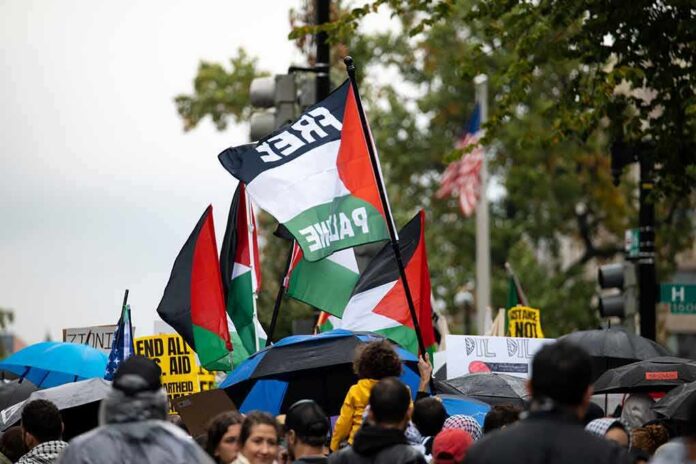
Cuba-linked activist groups are now facing a State Department report that says they could mobilize protests at U.S. military bases, Immigration and Customs Enforcement sites, and federal buildings.
Quick Take
- The report points to a public “National Rapid Response Plan” tied to the National Network on Cuba.
- The plan calls for protests at military bases, Immigration and Customs Enforcement facilities, and federal buildings.
- The State Department links the network to the Cuban Institute of Friendship with the Peoples, known as ICAP.
- The report also names groups such as Code Pink, the People’s Forum, and the National Lawyers Guild.
What the State Department Says
The State Department report says the National Network on Cuba distributed a public protest plan aimed at U.S. military bases, Immigration and Customs Enforcement sites, and federal buildings. The report also says the coalition works closely with ICAP, a Cuban government entity that the State Department sanctioned in June for allegedly supporting Cuban intelligence activities.
That is the core of the issue. The report does not just describe friendly activism. It claims a foreign government has spent years building ties with U.S. groups that can be activated fast when policy fights heat up. For readers who worry about outside influence and weak border enforcement, that is a serious charge.
Why Conservatives Are Paying Attention
The report frames ICAP as the center of Cuba’s international influence effort and says the group coordinates solidarity organizations in more than 150 countries. It also highlights six U.S. organizations with overlapping ties to Cuban outreach and left-wing activism, including Code Pink, the People’s Forum, and the National Lawyers Guild. Those names matter because they sit near the center of the modern protest machine.
One of the report’s sharpest claims is that Code Pink has received about 25 percent of its funding since 2017 from groups tied to Neville Roy Singham. The report also says People’s Forum leader Manolo de los Santos has traveled to Cuba since at least 2009 and has appeared often in official regime media. The National Lawyers Guild, the report says, adopted a 2026 resolution to work with the Cuba solidarity network.
What Is Still Unproven
The public record in the research does not show direct proof that Cuba ordered or financed specific protest actions at U.S. bases or Immigration and Customs Enforcement sites. The report leans on travel records, public ties, and overlapping relationships rather than on a leaked order, a cash transfer, or a named intelligence officer directing the plan. That leaves room for critics to argue the evidence shows contact, not command.
The US State Department says: : Cuba "has infiltrated the highest reaches of the US government, recruited and cultivated generations of American activists (and) backed an unprecedented wave of left-wing terrorism on American soil."
This statement by Lunev says differently. https://t.co/ZYDElAxASi
— J Anderson (@Anderson10x3) July 21, 2026
There is also a separate but related investigation. Fox News Digital reported that Justice Department and Treasury Department officials are looking into 145 nonprofits and activist groups for allegedly coordinating with Cuban officials as part of a foreign influence campaign. That probe is still described as alleged coordination, so it is not a final legal finding. Still, the scope alone shows how seriously federal officials are treating the issue.
Cuba’s Denial And The Bigger Fight
The National Network on Cuba has rejected the State Department’s report and called its claims untrue. That response matters, but it does not directly answer the report’s specific evidence about ICAP, the rapid-response plan, or the highlighted groups. ADN Cuba also reported that the network developed a nationwide rapid response strategy to make a possible U.S. military intervention in Cuba “politically and materially costly”.
That is where the bigger fight sits. Supporters of the report see a pattern of foreign influence wrapped in activist language. Critics see a political attack on legitimate dissent. The truth depends on how much hard evidence comes forward next. Until then, the report has put a bright light on Cuba’s reach, the activist groups around it, and the weak line between protest and foreign influence.
Sources:
redstate.com, en.cibercuba.com, state.gov, raceandequality.org, washingtonpost.com